Marc Morel · Programs · 3 min read
Why programs fail and how to make your next one a success
I have spent the last 25 years in tech. Along the way, I have watched many programs fail. A few failed loudly, with cancelled contracts and difficult board meetings. Most failed quietly. Deadlines slipped one sprint at a time. Budgets stretched. Scope was trimmed until what finally shipped was a shadow of what had been promised.
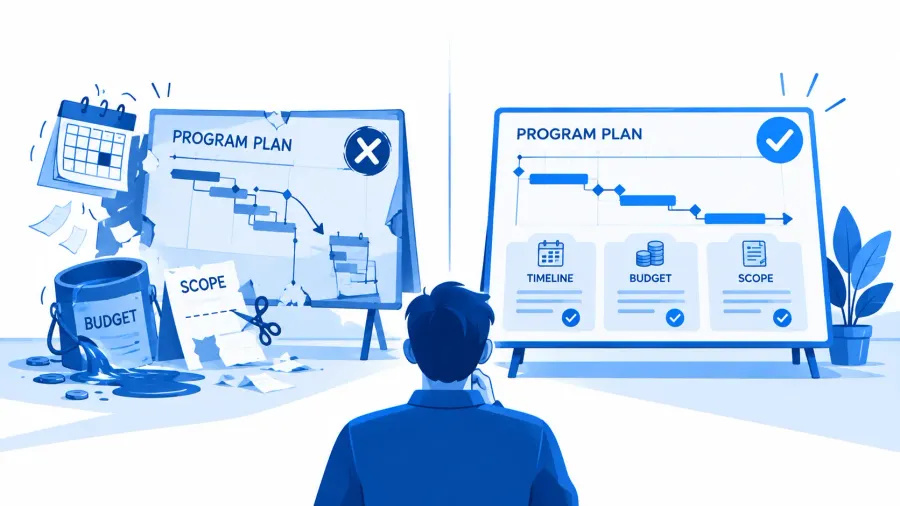
You probably know the moment.
It’s a steering committee like any other. The slides are mostly green. Someone says the delays are “under control.” Everyone nods, and the meeting moves on.
But somewhere around the table, someone feels a quiet knot in their stomach. They know the program is drifting. They just don’t know yet how to say it, or what to do about it.
If you’ve ever been that person, this series is for you and if you wan’t to never be that person, it is for you too.
Twenty-five years, and the same traps
I’ve spent the last 25 years in tech: as a CTO, as head of architecture, as a consultant. Along the way, I’ve watched many programs fail.
A few failed loudly, with cancelled contracts and difficult board meetings. Most failed quietly. Deadlines slipped one sprint at a time. Budgets stretched. Scope was trimmed until what finally shipped was a shadow of what had been promised.
And here’s what struck me most. No program I’ve seen fell into every trap. But almost none fell into just one.
Failure is rarely a single bad decision. It’s three or four well-known traps lining up, each one reasonable on its own, each one quietly making the others worse. The same traps, again and again, whatever the industry, the technology or the budget.
Why that’s good news
If the traps are always the same, they can be named. If they can be named, they can be spotted early. And if you spot them early, you can avoid them, or find your way out before it’s too late.
That’s why I’m writing this series. What I know about failing programs cost me, and the teams I worked alongside, a lot of late nights, hard conversations and a few scars. I’d much rather you get it for the price of a good read.
Who this is for
This series is for you if you sponsor a program, lead one, work inside one, or have just been asked to “take a look” at one that isn’t going well.
Each article takes on one trap, and gives you:
- What it looks like from the inside, before anyone calls it a problem
- The early warning signs you can check in your next meeting
- Why smart, experienced people still fall into it, so you can stop blaming yourself or your team
- What actually works to avoid it, or to get out of it
What’s coming
Here are the traps we’ll explore together, one per article, the:
- planning trap
- perfection trap
- waste trap
- decision trap
- speed trap
- scope trap
- people trap
- integration trap
- watermelon trap
- go-live trap
You’ll probably recognize a few of them. That’s normal. Recognizing them is where it starts.
Let’s make your next one a success
One last thing. If you work in tech, you’ve lived through a program that went sideways. I’d love to hear your story: which trap caught you, and what you’d do differently today. Write to me on LinkedIn. The best lessons in this series may well come from you.